1
Cornhole (beanbag toss)
An easy-to-learn target game that works for adults, mixed ages and friendly competitions.
Searching for lawn games or fun games on grass? Start here. Find something that fits your lawn, learn exactly how to set it up and score it, and choose games for kids, adults and people who would rather sit and play. We also show you how to turn a few simple games into a memorable backyard party with music and a mini tournament.
If you only choose three: pick cornhole for instant fun, bocce for relaxed guests, and Finska for strategy. Have a tiny grass patch or mostly seated guests? Swap Finska for Hookey or quoits. Three games that suit the people you invited beat twelve unused sets on the lawn.
Tell us about your space and guests. We’ll suggest a playable combination rather than a random list.
These are approximate, practical distances and casual match lengths — not competition requirements. Filter the options, then jump directly to the full rules.
An easy-to-learn target game that works for adults, mixed ages and friendly competitions.
A satisfying mix of aim, number choices and last-minute comebacks.
Gentle, social and easy to return to between food and conversation.
Fast turns and almost no running make it a good game beside the picnic table.
An Australian favourite that can be played from a shaded seat.
One wobbly stack turns a casual group into an audience.
A laid-back garden classic with more decisions than it first appears.
Knock down wooden blocks in a tactical team game with a dramatic finish.
A strategy game for people who would rather think than chase a ball.
An instant game for kids, family groups and relaxed backyard celebrations.
Two people can have a lively rally without losing balls over the fence.
The easiest way to turn a grassy afternoon into a shared Australian memory.
Each guide explains the equipment, the actual steps, scoring, a useful party variation and how to make it more accessible. The linked shops are independent retailers; Speaker Hire Hub hires speakers and microphones, not these game sets. The rules marked as casual or house rules are deliberately simplified for parties.
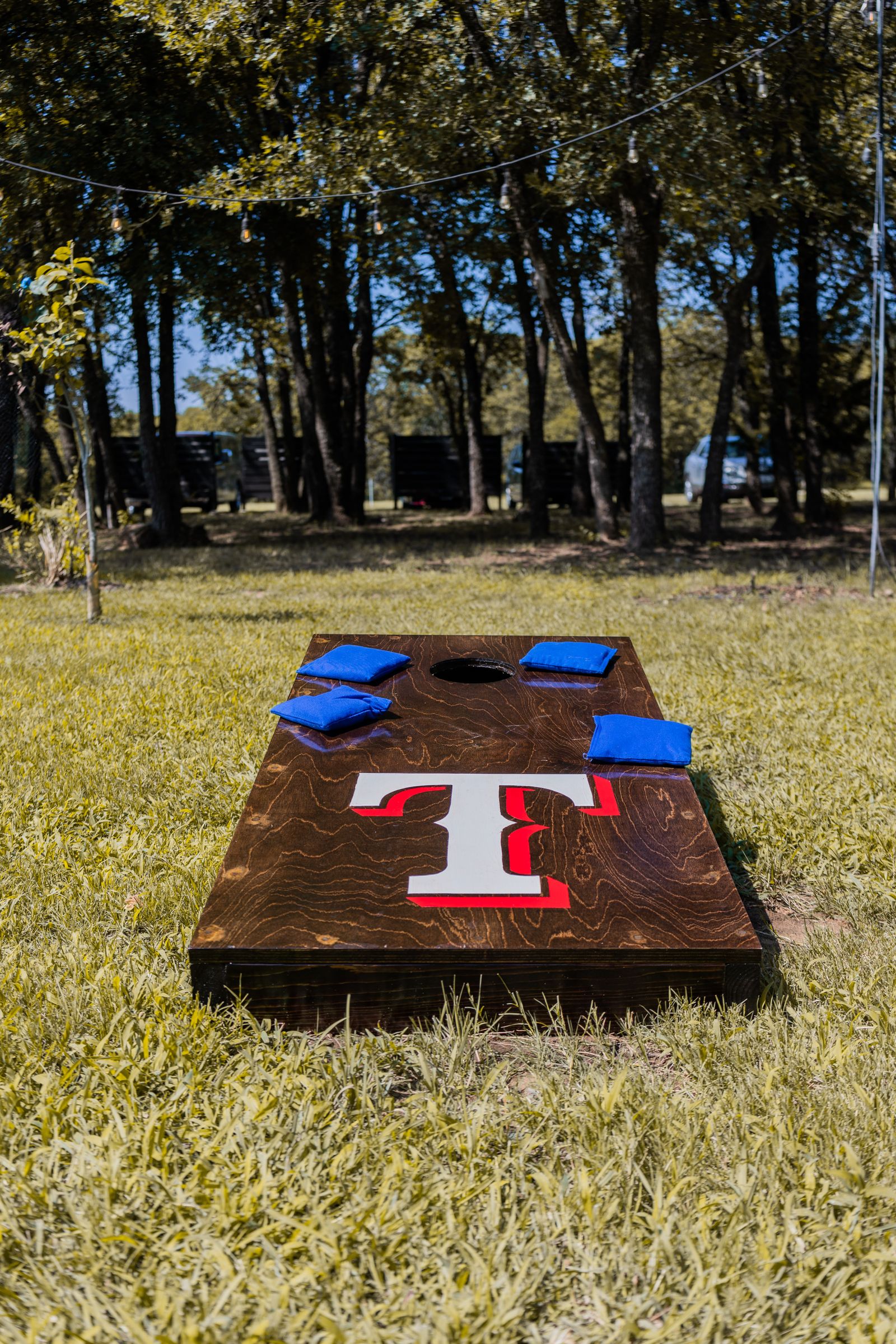
What you need: Two angled cornhole boards and eight bags in two colours. A compact board set is fine for a home party.
Place the boards opposite each other or use a single board with a clearly marked throwing line. Use a shorter distance for beginners: around 3–5 m works for many casual backyards. Keep a clear retrieval path so no one steps into an active throwing lane.
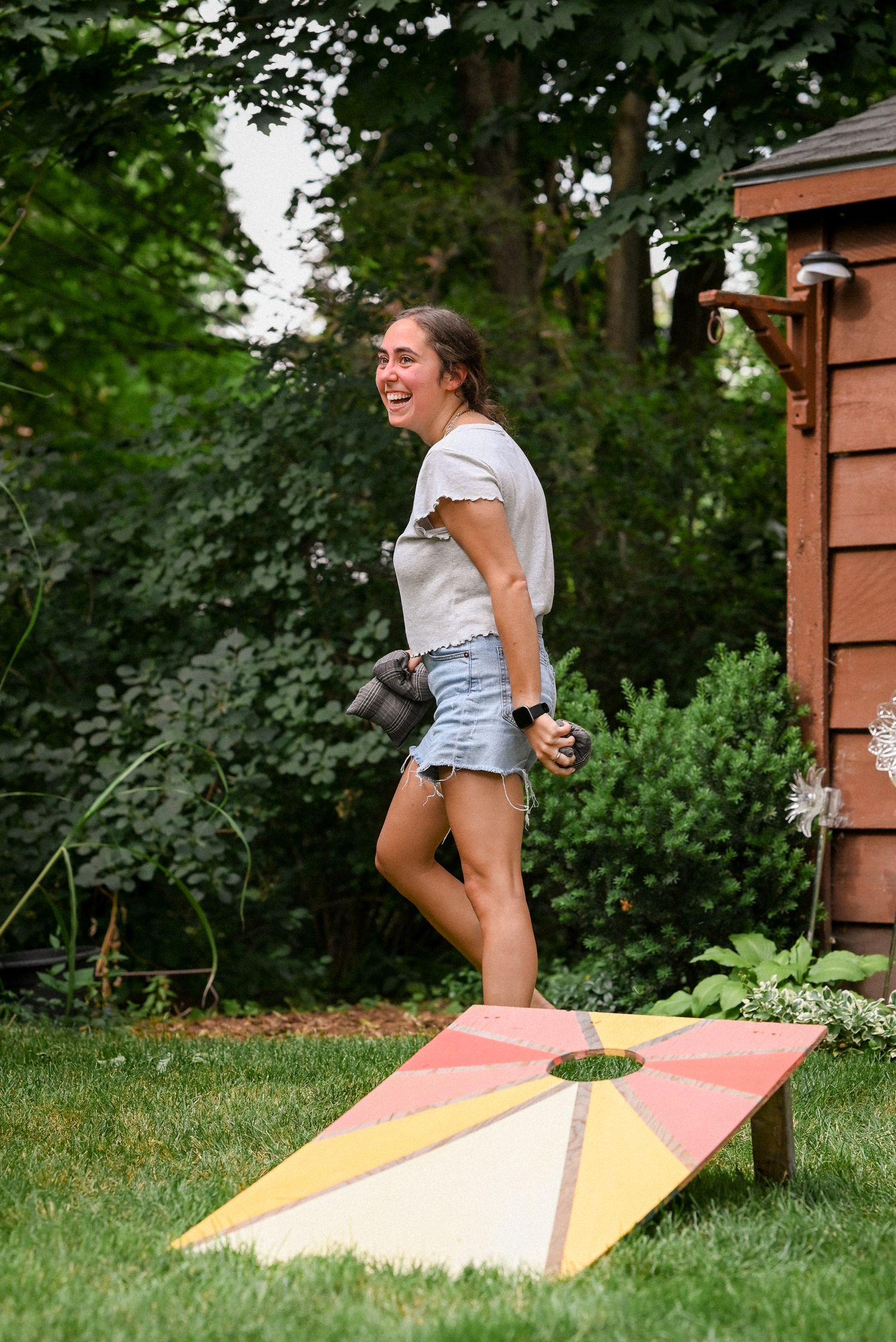
Players alternate underarm throws, aiming to land bags on the board or send them through the hole. Give each player or team four bags per round. Do not move a bag until all eight have been thrown; bags can knock other bags off the board. With four players, partners stand at opposite boards.
Score three points for a bag in the hole and one for a bag resting on the board. For an easy party version, add all earned points and race to 21. For a more competitive match, use cancellation scoring: subtract the lower team total from the higher total each round. State which version you are using before starting.
Run 10-minute pairs matches, put the winning pair on a simple scoreboard and play a short walk-on song for the final. It feels more like a mini event without slowing the game.
Smaller-space / seated note: Seated players can throw from a stable chair with a nearer line. Keep the board at a suitable distance rather than insisting on regulation dimensions.
What you need: A Finska set: 12 numbered pins (1–12) and one throwing log, plus paper to track scores.
Stand the 12 pins together according to the set’s starting arrangement and mark a throwing line about 3–4 m away for casual play. Everyone throws from behind the same line. Keep spectators out of the direction of throws.
Players take turns throwing the log underarm. If just one pin falls, the player scores that pin’s printed number. If two or more pins fall, the score is simply the number of fallen pins, not the sum of their numbers. After scoring, stand each fallen pin up exactly where it finished lying, so the targets gradually spread out.
The first person or team to reach exactly 50 wins. Go over 50 and your total drops to 25. Three consecutive scoreless turns eliminate that person or team under standard Finska rules. This means someone on 48 should aim carefully for a two-point result, not just the largest pin.
Write scores in large numbers. Have the MC announce “Sam needs four to win” before the key throw, then play a tiny victory sting after the final hit. Those decisions are what make Finska fun for people watching.
Smaller-space / seated note: For mixed ability, let beginners move a metre closer; play in teams to reduce waiting. It is still a throwing game, so allow a clear safety corridor.
What you need: A bocce set with coloured balls and one small target ball (pallino). Softer or lighter sets are easier for mixed-age groups.
Choose a reasonably level strip of grass and mark a start line. One team tosses the pallino about 3–6 m ahead. On a short or uneven lawn, make the playing area smaller and remove obstacles rather than forcing a long throw.
Each team tries to get its balls closest to the pallino. Teams alternate strategically: in conventional play, the team currently farther away keeps throwing until it has the nearest ball or has used all its balls. Players may knock another ball aside. Let everyone finish their allotted balls before measuring.
At the end of an end, only the team with the closest ball scores. It earns one point for each of its balls nearer to the pallino than the opposition’s nearest ball. A tape measure settles close calls. First to 7 or 11 is plenty for a backyard party.
Make bocce the “conversation station” away from the lively cornhole lane. Low-level background music works here; shouted commentary is rarely necessary.
Smaller-space / seated note: Roll rather than throw, shorten the lane or use lighter balls for seated guests. Never place seated players in the path of returning balls.
What you need: A wooden peg target and rope rings. You can improvise a soft ring-toss game using safe wide plastic rings and a stable target.
Put the target on flat ground and mark a line 2–3 m away. Ensure the target cannot wobble or become a trip hazard. Children and guests who want an easier round can use a nearer line.
Choose a house rule before the first throw: everyone gets five rings, tossed one at a time, and the ring must settle over a peg to count. Set a higher-value centre target if the board has multiple pegs. Collect rings only after the player finishes.
A straightforward scoring scheme is centre peg = 3, other pegs = 1; first to 15 wins, or highest score after three turns each. Manufacturer sets may use different peg values, so copy those values if you prefer. There is no need to pretend these are universal official rules.
Run a five-ring “beat the host” challenge. One turn takes under a minute, so late arrivals can join without disrupting another game.
Smaller-space / seated note: It works particularly well from a chair. Shift the line close enough for a comfortable throw and consider bigger, soft rings.
What you need: A hookey board with numbered hooks and soft rubber rings, hung or securely propped as its instructions allow.
Place the board at a comfortable viewing height and keep the ground around it clear. Mark a starting point roughly 1.5–2.5 m away. Secure the board so it cannot fall towards players. Avoid sharp improvised hooks.
Players throw the same number of rings — five is a good quick round — attempting to loop each over a numbered hook. A ring counts only when it stays on a hook. Let the next person throw after the previous player has safely collected the rings.
Add the numbers on hooks successfully caught. After three rounds, the highest total wins; use a one-ring sudden-death round if there is a tie. Since boards differ, play with the numbers printed on your set.
Give Hookey its own shaded corner near seating. It lets guests who don’t want an active game participate in the same tournament scoreboard.
Smaller-space / seated note: Ideal for some seated players, subject to their reach and comfort. Bring the line forward and make sure no one crosses the ring flight path.
What you need: A suitably sized wooden tumbling-block set and a flat, solid base or board.
Build the tower on a stable base on level ground, preferably away from bare feet, drinks and small children. A level patio or sturdy board on flat grass is usually better than lumpy turf.
On your turn, use one hand at a time to remove one block from below the top completed level and stack it on top. You may gently test blocks; follow the set’s house rules on touching and repositioning. Finish your placement and step back before the next player starts.
The person who causes the stack to fall loses the round. To make a tournament, give everyone who survives a round one point or award the winner of a knockout bracket a point for their team. Keep matches short: a whole afternoon of tower-only play means too much waiting.
Build the tower where people naturally mingle. No microphone is needed for each turn, but a short countdown for the final risky move makes a good group moment.
Smaller-space / seated note: Set the height low enough that players can reach without standing on anything. Heavy wooden blocks can injure feet; use a smaller lightweight version if appropriate.
Play a quick walk-on song for finalists, use a 10-second countdown for tie-breakers and put on upbeat music while teams switch games. For Melbourne backyard birthdays and team tournaments, hire a portable JBL party speaker to make it feel like an occasion — without turning the whole afternoon into a concert.
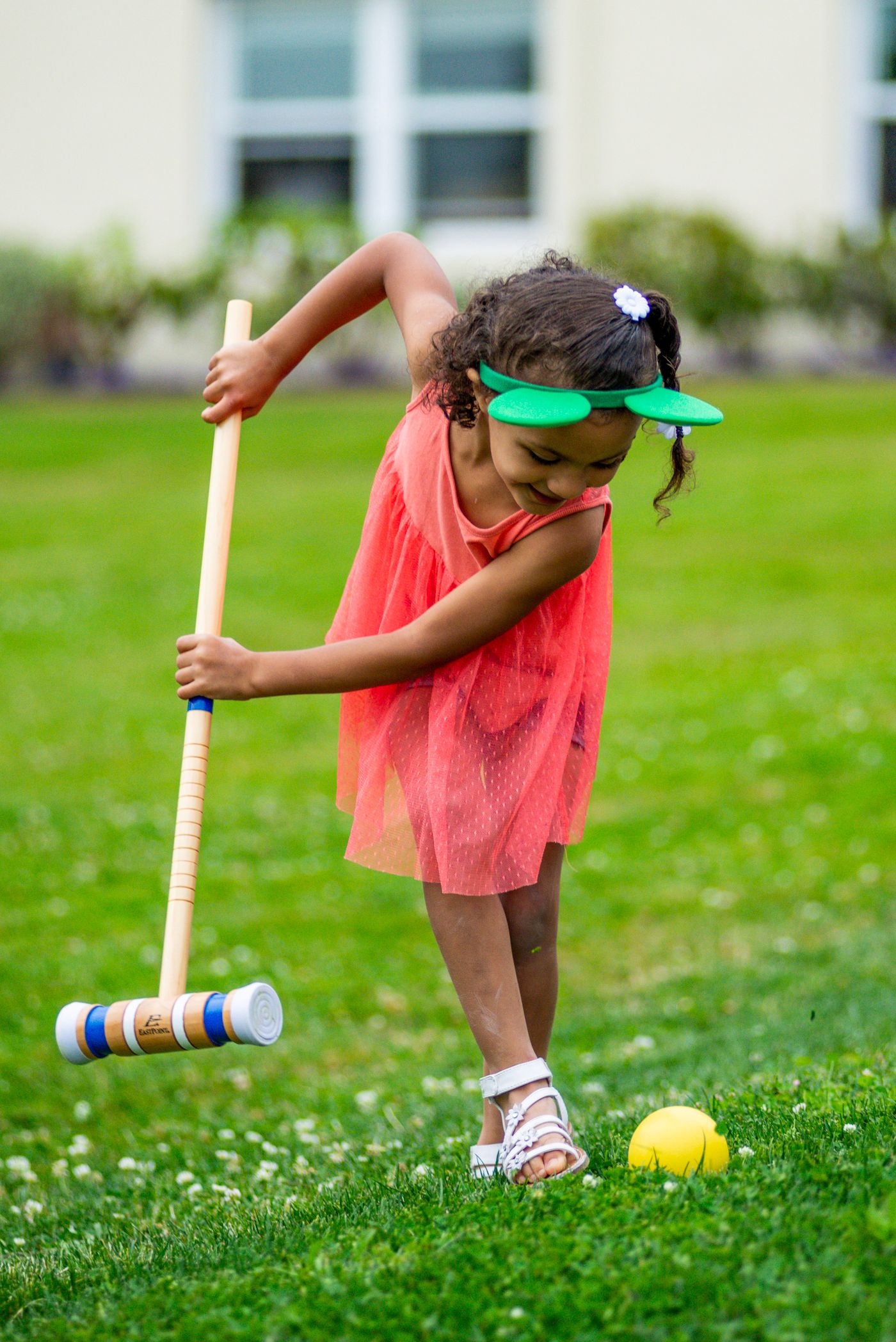
What you need: Croquet mallets, coloured balls, six hoops and a start/finish stake, depending on your set.
On a reasonably short, level lawn, arrange six hoops in a gentle zig-zag course. Put the start line near the first hoop and finish at a stake beyond the last. This is a simplified party layout, not an official competition court.
Players take turns using their mallets to strike their own coloured ball. The aim is to travel through the hoops in the agreed order. A ball must pass fully through the correct hoop in the correct direction for it to count. For a beginner-friendly house rule, allow one additional stroke immediately after successfully passing a hoop.
The first player to complete the six hoops and strike the finishing stake wins. If time runs out, the player who has completed the most hoops wins; break ties by who is closest to their next hoop. Explain this simple format on a small sign.
Use croquet as a slower morning or afternoon activity. If you are hosting a garden party, set it away from energetic ball games so players can actually line up their shots.
Smaller-space / seated note: Shorten the course and use broader turns. Players who need to remain seated may find bocce or Hookey more comfortable than swinging a mallet.
What you need: A Kubb set with 10 baseline blocks, six throwing batons, one king and corner markers.
Mark a rectangular pitch (often 5 × 8 m), put five baseline kubbs evenly spaced on each short end and stand the king in the middle. Set a designated throwing area behind each team’s baseline.
Teams take turns throwing batons underarm, end-over-end, at opponents’ kubbs. In the full game, downed kubbs are thrown into the opposite half and stood upright as field kubbs. The team must clear its field kubbs before targeting the opponent’s baseline kubbs. For beginners, practise a few rounds of baseline-only knocking down before introducing field-kubb rules.
Kubb is usually won by eliminating the required kubbs and then successfully knocking down the king. Hit the king early and your team loses immediately. For a party, play timed rounds and record a win rather than trying to assign points to every fallen block.
Use a microphone to introduce the two teams and explain the king rule once. It prevents 15 people giving conflicting instructions from the sideline.
Smaller-space / seated note: Because batons are wooden, avoid crowded and confined spaces. Choose softer throwing games if the guest group needs close-range play.
What you need: A sturdy outdoor four-in-a-row frame with two sets of coloured discs.
Put the board on stable flat ground with room on both sides. Check that the frame is secure, especially in wind. On a patio, place it so dropped discs cannot roll into a walkway.
Two players alternate dropping one disc into a column. Discs fall to the lowest open slot. The first person to make a straight run of four of their own colour — horizontal, vertical or diagonal — wins. If every slot fills without a four, declare a draw.
In a rotating party competition, use best of three games to decide each match. Switch the starting player after each round so neither person has the same opening advantage every time.
Set up a challenge ladder: winners stay on for one more match, then rotate out. It is naturally social and requires almost no explaining once the board is visible.
Smaller-space / seated note: One of the best choices for seated play if the board height is comfortable. Check reach to the upper slots before claiming it suits every wheelchair or chair position.
What you need: Six lightweight pins and one or two soft bowling balls. The linked budget set is a child-sized toy.
Choose an even strip of grass and arrange the pins in a triangle (3–2–1). Put a throw or roll line 2–5 m away based on age and ability. On long grass, players may need a slightly firmer rolling surface or a softer shorter lane.
Each player gets two rolls per turn. Reset only the pins left standing after the first roll if you want a basic bowling feel, or leave knocked pins down and aim for the rest on roll two. After both rolls, restore all six for the next player.
Count one point for each pin knocked down across the two rolls, maximum six points per turn. Play three turns each. Unlike ten-pin scoring, this intentionally does not use complicated spare and strike bonuses.
Turn it into a family-versus-family challenge with short 60-second rounds. A music cue before each final roll is fun if you have a speaker nearby, but keep the playing lane clear.
Smaller-space / seated note: Use a light ball and shorten the lane for seated players. Small sets are often designed for young children; choose equipment appropriate to your guests.
What you need: A tethered tennis pole and paddles; choose a model that suits the players’ ages.
Fix the base or stake exactly as the manufacturer instructs. Leave enough room for both players’ full swings and the rotating cord. Keep other guests well outside the circle.
Players stand on opposite sides and hit the tethered ball in opposite directions around the pole. In many sets, the winner is the first player to wind the ball or rotating arm to their end marker. Different sets use different scoring mechanisms, so check your model first.
For a no-fuss social version, play a best-of-five set: the winner of each race-to-marker scores one game. Switch sides between rounds. If your set does not have a winding scoring system, play 30-second rally challenges instead.
A good option for a high-energy corner, but never place it immediately beside music cables, tableware or people playing seated games.
Smaller-space / seated note: This is an active standing game and not the obvious choice for every guest. The linked Kmart set is specifically child-focused, so adults should choose a suitable full-sized model.
What you need: A plastic or wooden bat, stumps or a makeshift wicket, and a soft ball suited to the location.
Mark a batting crease and a clear boundary away from windows, cars and neighbouring fences. In a small space use a soft foam or tennis ball and ban high or powerful hits. Define which areas count as boundaries before the first delivery.
For casual play, one batter stays in for a short turn of six balls or until out. Use simple outs such as bowled, caught, or run out. A popular optional backyard rule is “one hand, one bounce”: a fielder can catch the ball with one hand after a single bounce. “Six and out” can keep shots from landing beyond the property — define it first.
Award runs for running between wickets or set boundary values that suit the yard. Try three overs per team with a capped number of batters so guests waiting to play are not stuck watching for half an hour.
Play a walk-on tune for each batter and announce the next pair. For a larger family barbecue, it adds event energy without turning a relaxed afternoon into a formal match.
Smaller-space / seated note: Use shorter bowling distances and a lighter ball. The linked very inexpensive Kmart set is a small children’s set, not adult match equipment.
Not everyone wants to run around a lawn. If your group includes grandparents, guests who prefer lower-energy games or people who need seating, make that a first-class part of the event rather than an afterthought. Choose equipment and distances to suit each person; “seated-friendly” does not mean every setup will be suitable without adjustment.
Mount the numbered board at comfortable eye height, move the throwing line closer and take turns with soft rubber rings. This is a proper seated game, not just a spectator activity. See Hookey rules →
Use a two-metre line and a soft ring set. Add a centre-peg bonus or a five-ring speed round. You can fit it near shaded chairs without monopolising the yard. See quoits rules →
Roll soft or lightweight balls towards a target 3–5 metres away. Shorter lanes can be just as competitive when everyone uses the same starting line. See bocce rules →
Print a 4 × 4 grid of song titles, give each player a pencil and play 15–20-second clips. Players mark matching songs; first row wins. A good speaker makes songs easier to recognise for everyone, including guests sitting away from the phone.
Run three rounds of five questions: local knowledge, food and a picture round. Let each picnic table be a team. With a large group, a wireless microphone saves repeating every question across the lawn.
Bring a large-print domino or playing-card set to a shaded table or mat. Make it a bonus station for guests who want to sit, chat and play without any throwing or standing.
You do not need all 12 games. Three stations and one person keeping time are enough to turn a casual gathering into a proper group activity.
Pick cornhole, Finska and Hookey or bocce. Divide guests into 3–4 teams; set up clearly separated throwing lanes and a shaded waiting area. Put a whiteboard or paper score chart where everyone can see it.
Explain each game in two minutes, then run 15-minute rounds with five-minute changeovers. Give 3 points for a station win, 1 for a draw and 0 for a loss. Rotate teams so everyone tries each station.
Count scores, run a short cornhole or Finska final, then gather the group for a two-minute winner announcement. A simple prize — a homemade trophy or first pick of dessert — is enough.
Host tip: Give one person control of the music and one person the score sheet (they can be the same person at a small party). Play a short cue when it is time to rotate. Music should stop or dip during rule explanations, not compete with the host.
A backyard tournament gets easier to run when everyone hears the same announcement. For larger Melbourne gatherings, the PartyBox 710 + two wireless microphones package lets the host call teams, give instructions and celebrate winners while still playing a soundtrack between rounds.
Without music, guests often drift between activities, and the organiser has to shout “next round!” repeatedly. Add a soundtrack, a few planned cues and — for a larger group — a microphone, and the same simple lawn games start to feel like a backyard mini-festival. The value isn't maximum volume. It's energy, timing and shared moments.
Play feel-good, conversational music while people pick teams and learn the rules. A consistent background soundtrack makes quieter moments social without distracting anyone taking a shot.
Choose a five-second sound cue for rotation, a short countdown for the final throw and a winner song for the final. People who are not playing still understand when something fun is happening.
For several teams spread across a backyard, a wireless mic carries short instructions and score updates without yelling. Turn the music down when speaking, then bring it back up between rounds.
When hire makes sense: if you have a small picnic with four friends and a decent home speaker, use that. If you're organising a 15–30-person birthday, a corporate social event, or multiple lawn-games-australia stations, reliable sound and a microphone become much more useful. In Melbourne, you can hire the setup instead of buying a party speaker you'll rarely use.
Portable · Bluetooth · Built-in lights · Battery or mains
Great when the goal is lively background music, quick match-change cues and a fun atmosphere without a complicated setup. Roll it into a covered spot, pair your phone and use one playlist for the day.
Powerful sound · Two microphones · Music-sync lights · Mains powered
Make the games feel like an actual event: announce team names, call the next round, explain rules once and bring everyone together for the final. Two mics help when a second person is keeping scores or presenting prizes.
*Indicative prices seen on Speaker Hire Hub in October 2026; check the linked page for current rates, inclusions and date availability. Both options must be kept sheltered from rain and liquids; the 710 requires standard 240V power. Equipment pickup: Clayton, VIC 3168.
The retailer buttons in the 12 game guides go to specific Australian product or brand pages checked while preparing this article. Kmart and BIG W are useful for basic sets; the official Finska shop stocks dedicated Finska equipment. All retailer links are informational, not Speaker Hire Hub hire inventory. Product prices, availability and suitability can change, so check the page and age guidance before ordering.
Save progress in your own browser, copy the list, or print it. None of these items requires booking anything.
Want more hosting ideas? Browse our party ideas and planning guides. For a summer celebration with games, food and music, see Christmas party ideas for Melbourne homes and backyards.